Reinventing Keyboard Layout: Simulated Annealing Optimization

I got a chance to work on a project in which I have to figure out, if we didn’t have the current keyboard layout, what would be the best layout?

To determine the best layout, we were given an objective function which, given a layout, gives you the expected words per minute (wpm). The objective function takes into consideration the bi-gram frequencies of letters, and since the assignment was in Finland, it considers bi-gram frequencies of the Finnish language. At this point, the problem turned into an optimization problem.

Continue reading Reinventing Keyboard Layout: Simulated Annealing Optimization

Eye Gaze for Video Annotation: Scrubs as a Use Case

People like to watch videos. The way videos transfer information beats any other media form (still photos, audio clips). Billions of videos are watched everyday. Can we use those free-watching habits of videos for video annotation and tracking objects in videos? I worked on a research project to try to answer this question.

Selection_086.png

Continue reading Eye Gaze for Video Annotation: Scrubs as a Use Case

PaperUI: Draw Your Own Interface

Have you ever thought of drawing your own interface? Say you have a music player app on your laptop, and you want to draw your own play, stop, next, previous buttons, and access the app from a distance, this is what the project is about.

PaperUI allows you to draw your own interface on paper, map it once, and then use it to control an app on your computer.

We used Leap Motion device, placed on a stand, which is attached to a clipboard. We used both a laser cutter (for wooden stands), and a 3D printer for the Leap Motion holder/cover.

schema
The structure

Continue reading PaperUI: Draw Your Own Interface

How Far Can Your Thumb Reach?

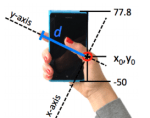
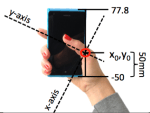
A common challenge that we all face, especially with the trend of making bigger phones, is reaching widgets far away from our thumbs reach, on our phones screens while holding them. Designers try to optimize that by placing most frequently accessed buttons in the most comfortable reach for the thumb (by using heat maps from test sessions or from live products). A recent paper proposes a model for calculating the thumb functional area[1]. By giving the algorithm four values, it calculates the area and plots it. The four values are:

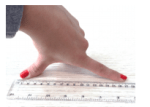
  1. Finger Span or Hand size (s): the distance between the thumb and index finger as shown in the figure
  2. Index-finger distance (d): the distance of the index fingertip from the point of intersection of the hand with the phone
  3. Hand orientation
  4. Hand position from origin

Continue reading How Far Can Your Thumb Reach?

Analyzing Clutter in Color

I was recently assigned a task – as part of my graduate studies – to analyze the clutter in colors in any interface. It was sort of a freestyle task: everyone should come up with his own approach. I chose to analyze the color feature congestion in the feature space[1]. The analysis follows the dominant color approach, in which a score is given for the variability in colors in images. Based on that, each image is given a score. The higher the score, the more the image is congested. Lower score means the dominant colors are close to each others, which implies that the feature space is not congested, i.e. uncluttered.
Continue reading Analyzing Clutter in Color

Rethinking PolyZoom: The Drawbacks

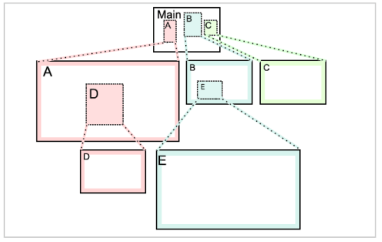
Me and my colleague Domonkos had a chance to work on a very interesting project: “PolyZoom: Multiscale and Multifocus Exploration in 2D Visual Spaces“. In simple words: the paper provides a novel hierarchical way of navigating through maps, which makes sure the user does not lose the context, and preserves both multiscale and multifocus awareness while navigating.
selection_087
Continue reading Rethinking PolyZoom: The Drawbacks